As testing season rolls around for many sophomores and juniors, the differences between various tests like the SAT and ACT can be confusing. Before you consider taking important tests that can have impacts on your college or job applications, it’s necessary to know the difference between them.
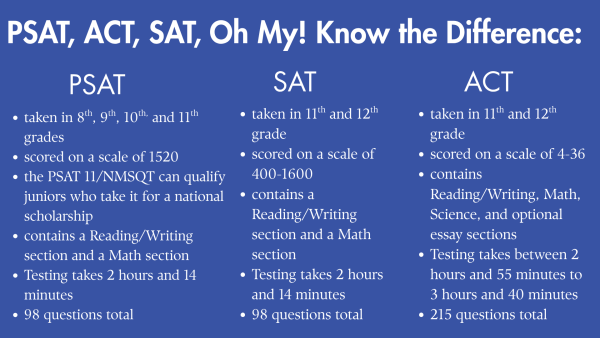
The PSAT, or the Preliminary SAT, can be taken in eighth, ninth, tenth, and eleventh grade. The PSAT taken in 10th grade, or the PSAT 10, is scored out of a maximum of 1520 points, with the Reading/Writing and Math sections accounting for 760 points each.
In eleventh grade, students can choose to take the PSAT/NMSQT (National Merit Scholarship Qualifying Test), which is scored like the PSAT 10, to qualify for the $2,500 National Merit Scholarship awarded to around 7,000 students across the country each year.
The National Merit Scholarship Corporation draws from the top 1% of test-taking students in each state, and names 16,000 semifinalists 2-3 months later. Winners are announced the fall after the test has been taken, when most eligible students are seniors.
Many college admissions officers recommend taking a PSAT at least once to measure test aptitude, potentially qualify for a scholarship, and to practice for taking the SAT or ACT in a low-risk environment.
The SAT and ACT are the two most widely recognized and accepted standardized tests taken by high schoolers. All United States colleges and universities consider SAT and ACT scores if added to a student’s application, even if they are test-optional. There are some key differences between the two, though.
Whereas the SAT is only offered online, the ACT can be taken with paper and pencil, and in some cases, is not available digitally. The ACT has only recently been digitalized, so many testing centers, such as those in rural areas, do not have the infrastructure to provide the online test.
The SAT is also shorter, with 154 questions issued during a two hour, 14 minute testing period. In contrast, the ACT gives the student two hours and 55 minutes to answer 215 questions.
There is also an optional essay section on the ACT, which provides the student with an opportunity to write an argumentative essay about a given set of perspectives on an issue. If taken, the student receives three hours and 40 minutes to complete the test.
The SAT leans heavily into evidence-based and problem-solving questions that are sorted into two sections: Reading/Writing and Math. On the other hand, the ACT has four sections: English, reading, math, and science, and is known for asking more direct questions.
The ACT is recommended for students interested in STEM fields because of its focus on science and math, but it is also a good fit for students who are confident in their writing abilities and can illustrate that in the optional essay section.
The SAT allows for more time per question than the ACT by around 30 seconds, so students who do not work well under extreme pressure may find it easier to take the SAT.
Overall, the ACT is scored on a scale from one to 36, and an SAT score ranges from 400 to 1600. If a student chooses to take the SAT multiple times, the best English and best math scores are combined for one total score even if they are scored during different testing sessions.
According to the Princeton Review, the average ACT score in the United States is between 19 and 20 out of 36. The average SAT score is around 1050, College Board reports.
However, a “good” score is entirely subjective depending on the student and the school they are applying to. Although many universities have offered test-optional admissions for students applying, test scores can certainly help boost a student’s application.
Mostly, though, it’s important to remember that test scores do not determine the overall worth of a student. Test scores are only a fraction of a college application, and statistics do not define any one student. To read a more in-depth critique of the academic validation crisis, check out this article by Diya Gandhi.
If you are interested in taking the PSAT, SAT, or ACT, I would recommend exploring College Board and Khan Academy for their SAT and ACT calendars, resources, and free prep courses, which can help students feel well-prepared before test day.