My name is Kitty Alexander, and this is my instalment of the Prowler’s Culture Corner. This one will be focused on Japan. Last summer, my family and I, along with many other RCHS students, travelled with EF Tours to Japan, and ever since, I have craved to recreate the phenomenal experience I had there back home. For those of you who also went on the trip, wanted to, or maybe just have an interest in Japanese culture, here are five things that I’ve gotten into that remind me of Japan. じゃ、行きましょう! (Let’s go!)
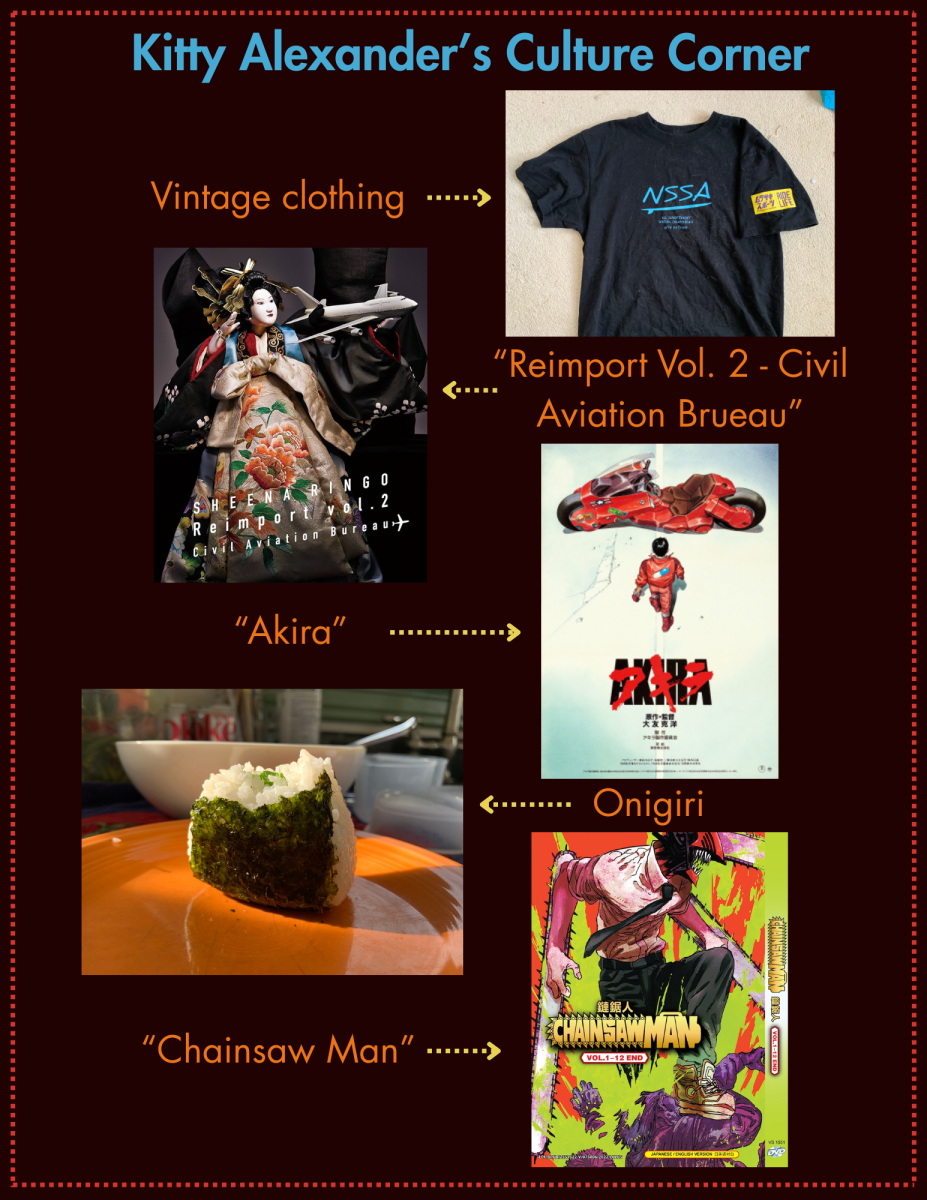
Something to wear is anything vintage. I only bought three shirts in Japan, two of which were vintage, and the other was styled to look like it was from the 90s. In one area of Harajuku, a place the EF Tours had us visit, there were nearly three vintage or second-hand shops on every street side! Japan also has a chain of thrift stores, equivalent to a slightly pricier GoodWill, called “Mode-Off,” that are sometimes multiple stories high, full of second-hand and vintage clothes. Many Japanese clothing aesthetics Pinterest users might be privy to are inspired by the American 80s and 90s, making the base qualification for all these clothes none other than vintage.
Something to listen to is Sheena Ringo’s album “Reimport Vol. 2 – Civil Aviation Bureau.” It is a fantastic blend of jazz, alternative rock, and the distinctive Japanese pop sound. Her other albums are good, but this one is my personal favorite because it’s 1) her best (in my opinion) and 2) reminds me of the jazz music piped into one of the デパート or “department stores” my family and I wandered around in.
Japan is known in the music community for their “J-fusion,” a subgenre of jazz fusion, of which is a mixture of American jazz and R&B. J-fusion adds its own city pop (another popular Japanese music subgenre) and almost disco energy twist. Sheena Ringo ties this and J-rock together so satisfyingly in this album, making it a highly encouraged listen.
Something to read is the international manga classic, “Akira” by Katsuhiro Otomo. When walking around in Japan, I could really tell how much of a hold the American 80s had on certain places, and reading “Akira” feels like I’m back walking on these same streets. Just now, these streets are overrun with motorcycle gangs and people with psychic powers. Otomo creates an indescribable ambience in “Akira” with his beautiful art and riveting characters, one that forces me to say just one thing: read “Akira!” You won’t regret it.
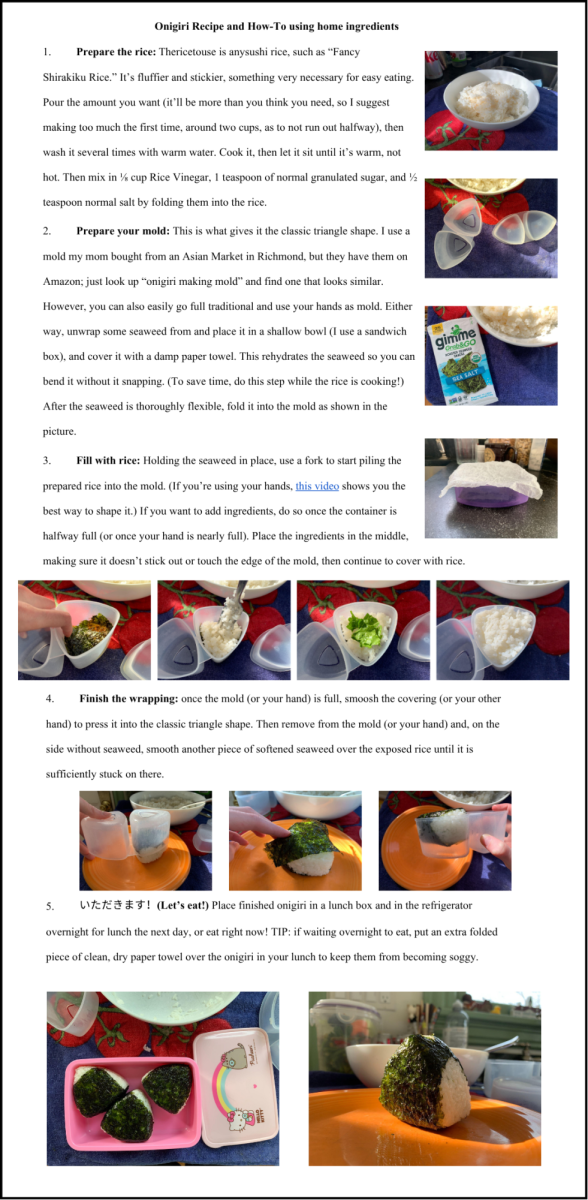
Something to eat is the コンビニ or “Japanese convenience store” staple, onigiri. おにぎり, as it’s written in Japanese, are the palm-sized rice balls Japan enthusiasts have probably seen floating around on the internet. Nearly everyone on the Japan trip last summer tried these, and I know I’ve been craving them ever since we got back. I had made sushi before in the past, so on the plane back to America, I was already planning to make them at home, but, to my surprise, they’re actually much easier to make than sushi! They come in a variety of fillings, such as seaweed, tuna mayo, egg, cucumber, various kinds of meat, and practically anything else you could think of. Filling, yummy, and kind of nutritious: it’s a win-win-win! I’ve included a step-by-step tutorial off to the side if you want to make them, too. Just a disclaimer, though: I’m by no means a professional, so all of this is guess-and-check! Link to video on how to shape them by hand.
Something to watch is the anime “Chainsaw Man,” based on Tatsuki Fujimoto’s manga of the same name. (I’ve already gone on a deep dive into one of Tatsuki Fujimoto’s other works, “Look Back,” linked here. I mention “Chainsaw Man” and how it relates in that article, for those who are interested.) I was torn between choosing between “Chainsaw Man” and “Evangelion,” both of which are fantastic, but ultimately I picked “Chainsaw Man” because of the cinematic brilliance of its anime adaptation. Even if anime isn’t your thing, the sound design and scene pacing on its own are outstanding enough to give it a view.
“Chainsaw Man” follows fifteen year old Denji, an aimless boy who, after a fluke incident with the mafia and some land sharks, gets reborn with the heart of the Chainsaw Devil, a small, dog-looking creature that exchanges Denji’s humanity and heart for the power to transform into a Chainsaw Man. It’s a wild concept, but one that is so entertaining every step of the way.
As of right now, only the first season and movie of “Chainsaw Man” are released, but the next addition to the animated saga is suggested to release late 2026. Maybe it’s crazy to say a show called “Chainsaw Man” changed my life, but it has such a unique perspective on Japan and the world around it that it’s completely restructured my standards for a “good” show and how I represent people in my art.
For those of you who went to Japan last summer, or who want to travel to Japan in the future, hopefully these gave you a little nibble on what my family and I experienced there. Those who don’t have a notable interest in Japanese culture, maybe now you do! In short, I love Japanese media, and I hope some of my recommendations help you to love it, too. Thank you for reading!