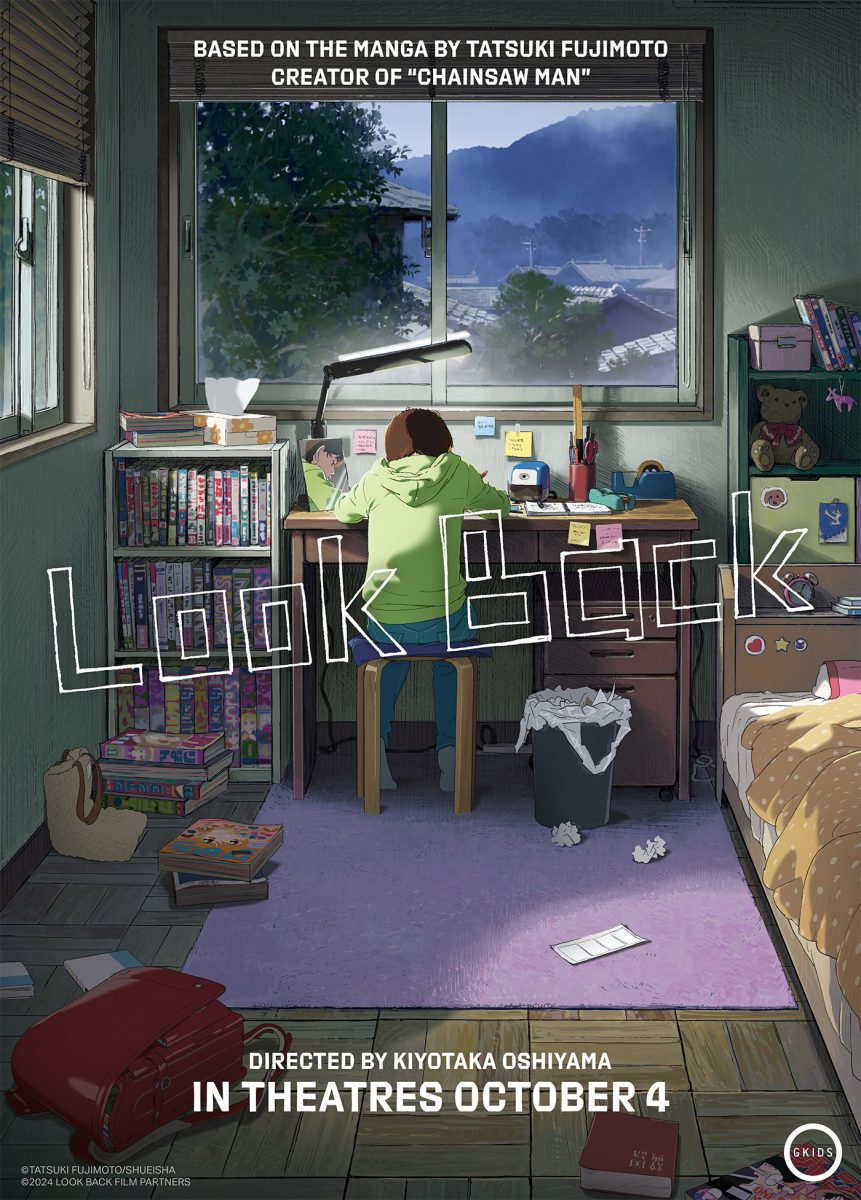
Warning! This article contains major spoilers for both the movie and book “Look Back.”
The animated film “Look Back,” or “ルックバック” (romaized “rukku bakku”) in its original Japanese title, was released to theaters in 2024 in Japan. It only runs for around 60 minutes, but received such praise at its original showing at the Annecy International Animation Film Festival in Annecy, France, June 9-15, that it was sent to theaters around the world, and quickly made its way to Amazon Prime Video in November of the same year (where you can still watch it now).
It is an adaptation of Tatsuki Fujimoto’s one-shot manga of the same title, and was directed by Kiyotaka Oshiyama. Tatsuki Fujimoto’s name might sound familiar; he is also the author of the groundbreaking manga, anime, and movie “Chainsaw Man” (of which Kiyotaka Oshiyama was an animator for the movie), along with “Fire Punch,” and over ten one-shots, including “Look Back.”
“Look Back” is a (some hypothesized autobiographical) coming-of-age story about two Japanese girls striving to be artists. Fujino, an arrogant middle schooler, draws a comic strip every week for her school newspaper. Her peers love her and her witty comics, but when their teacher suggests Fujino share her spotlight with another middle schooler, one whose social anxiety is too much to even attend school, Fujino sees just how amateur her own art is.
Kyomoto’s art is detailed and beautiful backgrounds, and next to Fujino’s childish human outlines, Fujino feels intimidated and inadequate. She resolves to get better than Kyomoto, and spends the next two years constantly drawing and sketching and practicing to do so.
Eventually, due to Fujino’s teacher’s interference and some good old chance, Fujino and Kyomoto finally meet, and Kyomoto reveals just how much she admires Fujino and her art. Fujino, shocked that her self-proclaimed rival has been her biggest fan the whole time, plays it off by casually telling Kyomoto that she’s working on a one-shot (a short, one-volume story), and that Kyomoto can help if she wants.
This is the beginning of their time as artists together. They write many one-shots that get published, and they spend every moment of time they have drawing with each other. Years pass, and they finally get the offer to be serialized (to have an ongoing work that gets a chapter published every week). Fujino is thrilled, but Kyomoto says she can’t work with Fujino on it; she wants to go to art school, alone. Fujino, still brash and impulsive, gets into a fight about this with Kyomoto, and they never speak again. Fujino works on the serialized manga by herself, and Kyomoto goes to art school.
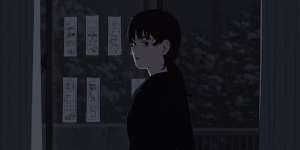
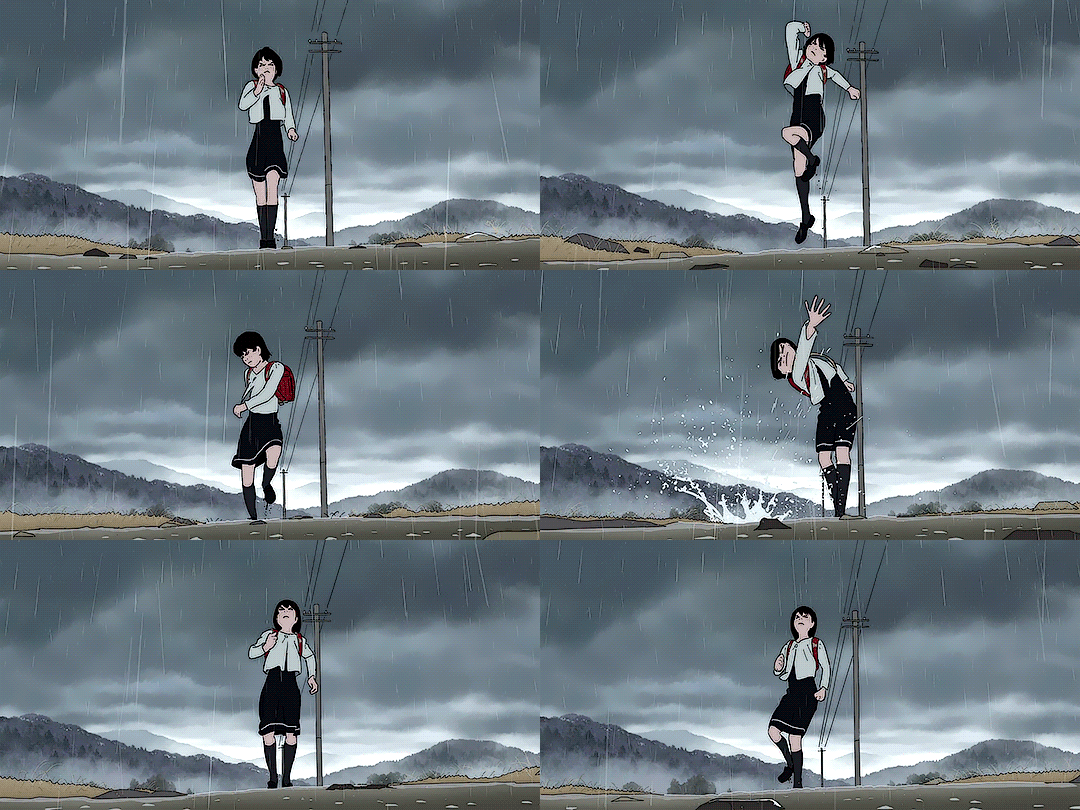
This is where watchers of the movie “Look Back” remember just who the author of this story is: Tatsuki Fujimoto, famous for his grotesque and violent other stories because, while both of the girls are working on what they’ve dreamed of, albeit individually, a crazed man breaks into Kyomoto’s art school and murders her with an axe. Fujino, understandably upset, visits Kyomoto’s middle school room for the last time, and sees all the comics of her own that Kyomoto has saved starting in middle school and leading up through the serialization of Fujino’s manga, even after their fight. Kyomoto admired Fujino to the end, and Fujino must live with that knowledge as she continues her own life and art.
“Look Back” is immaculately written and animated, and in short, absolutely deserving of all its praise. One thing it frequently gets praised on still to this day, nearly two years since its theatrical release, is the numerous layers left in a heaping pile over this 60 minute movie. One layer that stuck out to me in particular was as follows.
Floating around in the film “Look Back” is this underlying tone of hostility towards art, something so peculiar for this very artistic film. Some of that may come from the author himself, Fujimoto, with his love-hate relationship with art (more context on that in this interview (translated into English from Japanese)). This tone comes in the form of dialogue from other characters.
Early on in the movie, when Fujino is nose-deep in a drawing during a free time at school, one of her friends walks up to her desk and tries to talk to her. When Fujino replies only with one-word responses, too engrossed in her task at hand to fully pay attention, her friend complains.
“But aren’t you getting too old to keep drawing? You don’t hang out with us anymore,” she says. “Even when you do, you’re always drawing and you don’t talk. Not to mention, if you keep drawing in middle school, people will think you’re a creepy otaku, you know?”
While Fujino’s friend is valid in expressing her frustration in Fujino’s unwillingness to hang out with her, this strangely placed comment still stands. Around a minute later, there is a similar interaction between Fujino, now in her room still drawing, and her older sister.
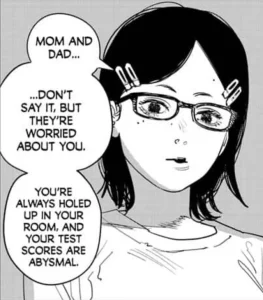
“How long are you gonna keep drawing manga?” her older sister says. “You should join my karate class. You can put it in your school report.” She continues, “Mom and dad don’t say it, you’re always cooped up in your room, and your test scores are terrible.” Again, the frustration from her older sister and family is valid, but this underlying resentment against art and drawing stands out.
There is one more direct quote that emphasizes this, and this time it’s from Fujino herself to Kyomoto years later when Kyomoto explains why she cannot co-write and illustrate the new serialized manga with Fujino; Kyomoto wants to go to art school. Fujino, resentful and feeling abandoned, shouts, “but there’s no point in going to art school. I heard there are no job prospects even with an art degree.”
What is driving this negative sentiment towards art? What is fueling Fujino, and by extension Fujimoto himself, to say these things? While I cannot peer into Fujimoto’s brain and find why he wrote this into his story, it does remind me of something in my own brain, the phrase common amongst online art communities, “school kills artists.”
Now, please don’t be alarmed; this phrase is not representing physical harm being done to students by a school. It instead refers to the idea that schools, the main environment for developing children and teens, prioritizes intelligence in ways they can measure with numbers. One hundreds for smart students, fifties for those who struggle, lower numbers for those who will get written off as “flunkies.” The main goal of schools is to get everyone on the level of 100, to make every child in the building meet the standard that societal norms have considered acceptable. However valuable and fundamentally crucial this scoring is to humanity’s progression into greatness, it is often misused simply because of a lack of time and funding.
Because the standard for knowledge is not changing but the dwindling resources are, administrators and teachers are forced to make shortcuts to survive in their demanding environment. This often is reflected onto the students in the forms of excessive outside work, lack of thorough coverage on crucial topics, and even more outside work. This is not a slight at teachers; the truth is unfortunately there is simply not enough time for teachers to allow students (or themselves) patience to progress at their own rate or take the time for mental breaks, and this is where the phrase “school kills artists” comes into play. By prioritizing scores on tests rather than comprehension of the content, students are forced to adapt to a habitat fit only for a very specific type of mind. Their mindset might change to think, “there is no time for drawing because my science homework must be completed; there is no point in painting because it won’t get me a job; there is no benefit to spending money on clay when I could spend it on a tutor or, let’s be honest, more solved questions on MathSolver.”
School has a knack for fostering an environment where a kid walking in with a sketchbook and a dream walks out with either a diploma in hand or a barely passing grade and only feeble dreams of “just being able to get up in the morning.” Thus, the little artist that first entered the building has been “killed” by the “real world,” or, “school.” (Once again, I would like to remind readers that this is not a criticism of teachers, administrators, or even the school system itself in any way, rather a directed comment at the demands required of such people and the continued lack of pay. This is what happens, and what we as a community are sacrificing, when we deny the people who contribute the most to us the resources they really need. This is what I see a problem with, and what I believe is the message behind this particular internet phrase.)
But, how does this relate to “Look Back?” How is this what I think of when I hear lines from Fujino’s friends and sister when they criticize how she is “wasting” her time? I tie it back together by reminding myself of where I was only a few years ago.
“Look Back” shows us the dangers of art, or rather, the dangers of living. But it also shows us the life you can lead when you pursue your passions. Up until around the eighth grade, I had a dream of writing and illustrating my own book one day. It was my motivation to constantly draw and write, and was all I could think about when in need of a muse. Once I hit the eighth grade, though, adults around me started talking about what I should plan to do with my life.
“Writing is good,” they would say, “but you can’t make a living off it.” This isn’t a slight at them, because they’re unfortunately not wrong. Unless someone is a reporter, communications officer, or ghost writer, writing for an income is very difficult (and even these jobs can pose a serious challenge for paying the bills).
By the time I got to high school, I started thinking practically. I wanted to do art for a living, so why not become an art teacher where it could be my job? Well, we all know teaching doesn’t pay, so what about a graphic designer? Spoiler alert, I hate graphic design. Commercial artist? 3d modeler?…
A few years passed, and now in my Junior year, I was fortunate enough to find a passion for medicine. Finally! Something that can be an actual job and pays!! And so, I set my sights on becoming a doctor.
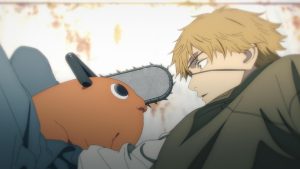
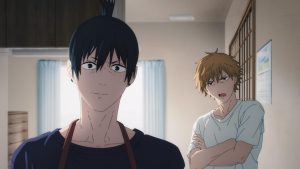
This entire time, though, the dream I once had of writing my own graphic novel had completely faded into the background, utterly forgotten and trashed. That was until over our week of snow days, I finally watched “Chainsaw Man,” and later this movie, “Look Back.” I was blown away by the sheer talent and passion that Fujimoto smothers his work in, and it reminded me of the passion my younger self once had for my own art.
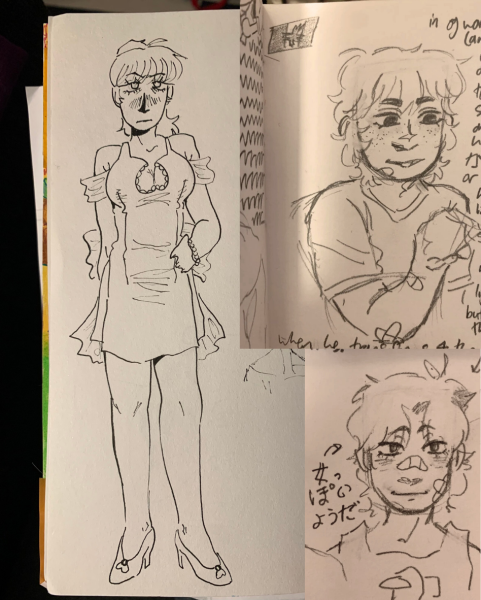
My art in this time had become a side-hobby, a task, if you will, in the form of a last-ditch effort to lift my mood in times of stress. Something I did whenever I could, but not something I could ever prioritize. I dropped all my original characters and only drew quick sketches of easy things that would pose no challenge, like the same face over and over again on characters with hats to hide hair, something I struggle with.
But, watching these shows took a defibrillator to the part of me that always wanted to be an artist. School had made me forget that. No one around me was talking about the advantages of being an artist or the happiness one can get from it, only the disadvantages, and I honestly can’t blame them: it doesn’t pay; you can’t get a real, stable job from it; art school is expensive, and it’s all for what? So you can draw a hand slightly more accurate?
The moral I get from “Look Back” and “school kills artists” is this: it doesn’t matter if it pays off, pays the bills, or if it kills you (hopefully not literally); it matters if it makes you happy. Fujino and Kyomoto are their happiest when they’re drawing together in middle school. Fujino eventually loses sight of that happiness when her rash personality takes over, but with Kyomoto’s death, she realizes she was the only one; Kyomoto never lost sight of this happiness, and that’s why she was so free at art school, even away from her best (and kind of) only friend.
The “school kills artists” idea isn’t about school actually harming artists, it’s about not giving them time to remember and appreciate why they’re here and why they create. As a student, there’s not really a way you can fix this. Asking for no homework, no matter how hard one might try, never seems to work, and skipping school or simply ignoring this work isn’t the answer either.
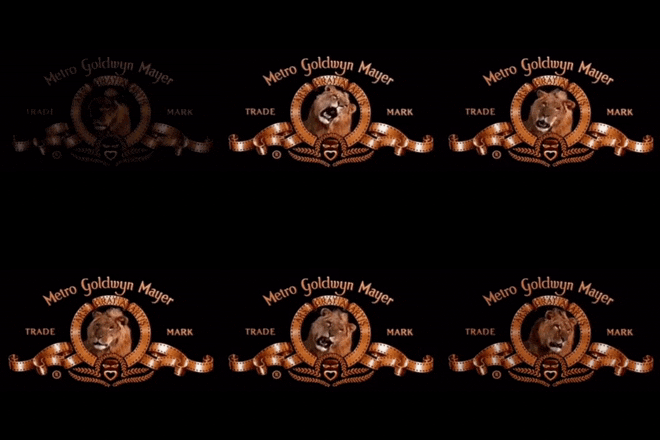
When it comes down to it, and to be perfectly honest, you probably can’t do art for a full job, and even if you do, you won’t be doing it for art’s sake. You’ll be doing it for money’s sake. It will become a job, a task, a chore, and that’s not what art is supposed to be. Even in the first few seconds of watching “Look Back,” there is the Metro Goldwyn Mayer trademark logo (the gold one with the lion that people might be familiar with) with the inscription of “ART FOR ART’S SAKE” on the top.
Instead, I personally encourage students to prioritize school and work and whatever responsibilities they might have. These things are important, there’s no doubt about it. But don’t forget about your art. Even if you don’t draw for months, even if you don’t pick up a pencil for anything other than math class, even if you don’t paint or sing or craft until you’re not even sure you can anymore, don’t let yourself forget what your motivation is or why you create when you do. When you have the time, surrounding yourself with your hobbies will be much easier, enjoyable, and more stress-relieving when you aren’t also passively aggressively wondering “why even do this at all?”
Now, when I sit down to draw, I don’t think “I have to enjoy this while I can” or “this isn’t helping me become a doctor” (fun fact, the hand-eye coordination and problem-solving that comes from making art is actually very valuable to many jobs, doctors included), but instead I think, “if I keep this up, maybe one day I’ll finally manage to publish that book I’ve been thinking about forever. It doesn’t have to happen now, it doesn’t have to happen in 50 years. But if I ever really do it, then all of this will be worth it.”
This mindset is, to me, the key to surviving in a world where art is second, and it does take some time getting into the habit of. But, I believe once one can find it, it is invaluable, just like the message of motivation and passion we can get from Fujimoto’s brilliant manga and film, “Look Back.”