Electronics and Robotics consists of three levels. In Electronics I, students learn the basics of electronics, circuits, and soldering. In Electronics II, students continue their education from year one, but at the end of the year build whisker robots. Finally, in the third level, students get to choose a project to complete over the year.
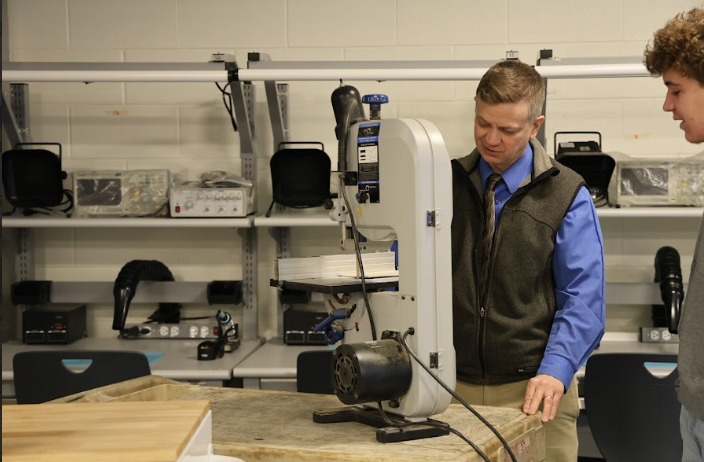
Electronics teacher Alton Jarvis helps students throughout the year complete their projects. He talks about the final year of the course.
“Electronics III is really the senior capstone year of the electronics course. Students don’t necessarily have to be a senior, they’re going to be a junior or a senior because it is the third level. The students get to select projects that they would like to spend the year building and working on. It’s not always robotics, although it most often is,” Jarvis said.
Jarvis then describes how students get their projects approved and what he looks for in the project before he approves it.
“The students present me with a project and I approve it as it has to meet certain criteria. It cant be too easy and it cant be so difficult that it can’t be built or can’t be built within the time that they have,” Jarvis said.
Over the course of the entire year, students complete their individual projects. Jarvis explains what he hope students take out from their year.
“One of the things that I hope they do is enjoy their project and have a great sense of accomplishment with taking their past experience in electronics and building something that they are happy with at the end of the year,” Jarvis said.
Lastly, Jarvis explains how students learn a lot of skills that their would not normally learn in the first two years of class.
“Of course, as a teacher, I hope that they are learning new electronics information and that they are getting to do new things that you can’t really learn in the class setting. You can only learn certain things when you are doing a project because a project presents you with unforeseen problems that you have to solve,” Jarvis said.
Junior Will McDougle is one of the students completing the capstone project for Electronics III. He explains what his project is.
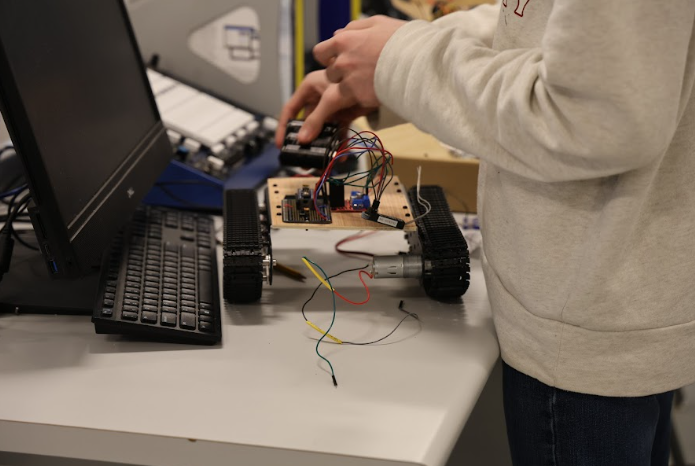
“This year I am building a robot controlled by this Raspberry Pi. It’s going to drive around using infrared sensors and hopefully it’s going to have line tracking,” McDougle said.
According to NIRYO, Raspberry Pi robots utilize boards like the Pi 4, 5, or Zero 2 W to act as the “brain” for autonomous or remote-controlled vehicles.
Junior Lucas Secoy is another Electronics III student that is building a robot for his capstone project. He describes what he is building over the course of this year.
“I’m building a robot for combat robotics, so the robot will have a lifting mechanism with the goal of being able to fight against other robots,” Secoy said.
Finally, junior Jack Davis explains his capstone Electronics III project that he is currently working on and he explains why he chose to take this course for a third year.
“I am building a remote controllable robot with an arm that’s controlled from the same remote. I chose to take this class this year because I love electronics and I hope to become an electrician in the future. I love working with my hands as well,” Davis said.
Electronics III offers students to take their education in their own hands and choose how they are going to spend their year. Whether it is building a robot utilizing Raspberry Pi, or a robot being built for combat, each student has an opportunity to explore their own interest over the course of this year.