
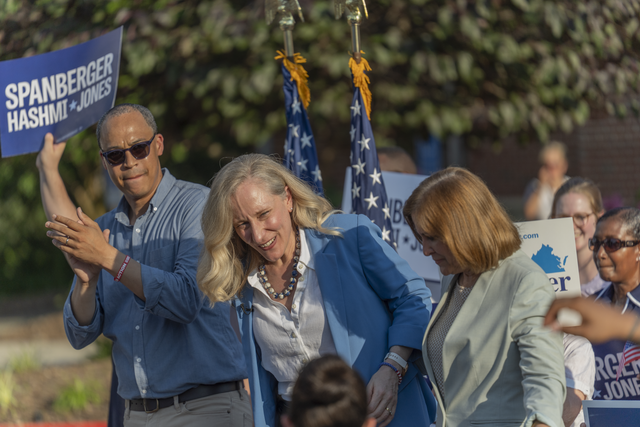
Virginia made history in November when Abigail Spanberger was elected as the first woman in the state’s history to become Governor. Her victory is an achievement in female representation in Virginian government, but it’s also a pivot in how Virginians look at leadership and governing. Her platform was grounded in affordability, a fair and equitable education system, and public safety, and that resonated with people affected by a particularly tough economic environment, and most of whom lived in major population centers.
Spanberger’s name is synonymous with public service. She served at the Central Intelligence Agency, later in the U.S. House, and is now a successful candidate for governor with practical visions instead of ultra-extremist, almost fanatical partisan ideologies. Her campaign website claims that when she’s elected into office, she’ll “strengthen our public schools, make Virginia more affordable, and keep our communities safe.”
Her opponent, Winsome Earle-Sears, the sitting Lt. Governor and first woman of color to serve statewide in Virginia, took a different tone to the race. Although Earle-Sears campaigned on themes of conservative and culture war, and called for “parents’ rights” in education, Virginia ultimately swung towards Spanberger’s message of stability.
This election matters to the students, families, and educators in Virginia. It’s not only about who won or lost, it was about how Virginia will be shaped throughout the next four years: how cost of living will be made affordable, how our education system will look, and whether there would be a promise of inclusion, or a promise of regression.
As a three-term congresswoman from a swing district, she built a reputation for working across party lines, ranking as one of the most bipartisan members of the U.S. House, ranking 5th on the Lugar Center Bipartisan Index for the 117th Congress. Even her rhetoric had shunned the national controversies that characterize current politics. Instead, Spanberger cast her candidacy in terms of “governing for all Virginians,” a slogan she repeated often. The approach speaks to suburban areas, and to rural communities, facing inflation and school divisions that are being targeted by political spin-outs.
The election was a choice for every Virginian: choosing between a path of regressive, polarization-based leadership or a pragmatic, forward-thinking, visionary way to go about governing, and the belief that progress comes from steady, collaborative work, rather than performative outbursts of hatred and anger.
When Spanberger takes office on Jan. 17, she will inherit a complex set of issues: soaring housing costs, economic stranglehold on rural communities, and the deep inequities that now determine opportunity across the Commonwealth. If her campaign is any clue, Spanberger’s approach to government is one of listening, deliberative decision-making, and a conviction that Virginia’s true advantage is its regional diversity and its history. As the Commonwealth turns the page, the question will be how Virginians will interact with this new society, and how they will engage in shaping the brighter future Spanberger is planning for.







Ruth Hylton • Dec 9, 2025 at 9:37 am
So relieved to know someone with common sense is leading our state.