“Is this your cab?”
“It’s not my cab.”
Insistantly, “Is this your cab?”
“Really, it’s not my cab.”
Shoving the other man into the car, “We’ll share.”
“I don’t want it.”
“No, we’ll share, I insist.”
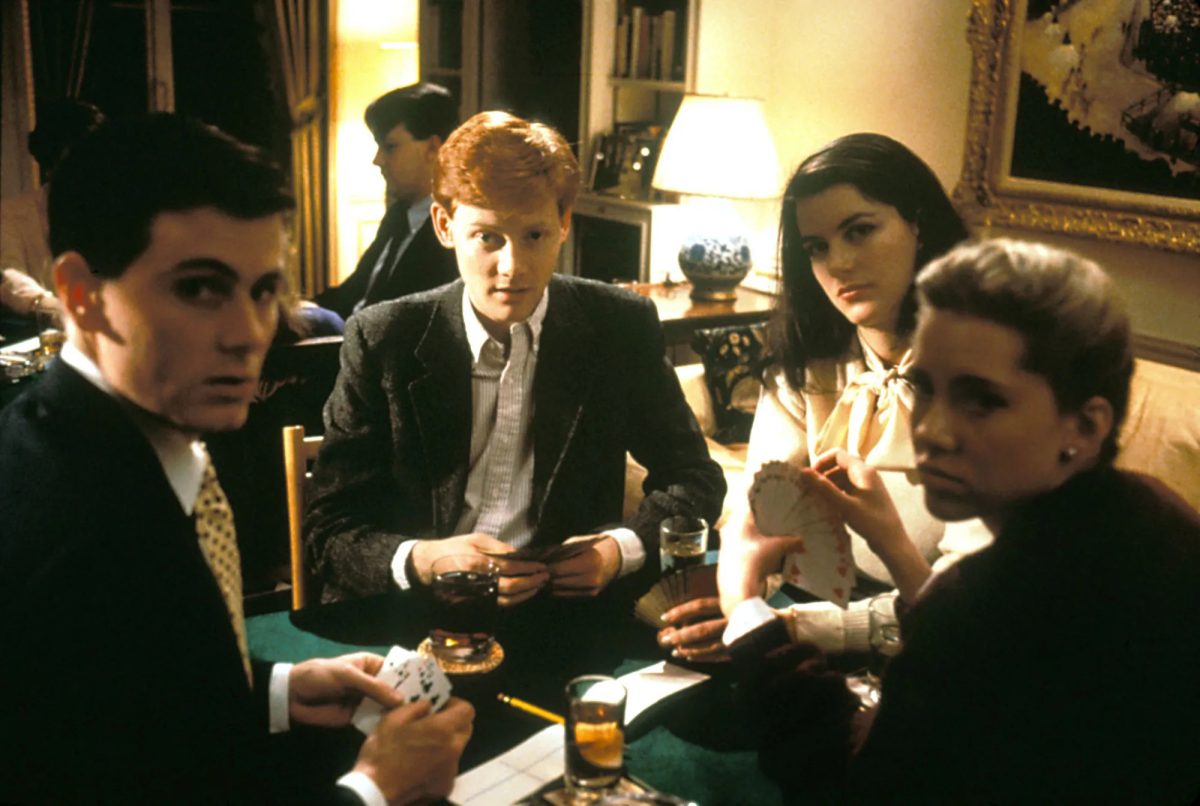
Later, about the man who didn’t want the cab, “He’s the guy who was sitting at the table behind ours, not talking to anyone all evening. Then outside, he got the cab that we were trying to flag down, but he insisted that we take it, so Nick insisted that he come along, too, so that there should be no hard feelings.”
This is the opening scene in the 1990 Whit Stillman movie “Metropolitan.” Immediately after it, the scene changes to the inside of a moodily lit room decked out in carved flowers and swirles in the wooden molding.
Another character, who is perched angrily on the edge of a lavish tan couch, argues to a bored woman in a yellow dress by saying, “Of course there’s a god, we all basically know there is.” The woman in the yellow dress interjects, “I know no such thing.”
The other man continues anyway. “Of course you do! When you think to yourself, and most of our waking life is, is taken up thinking to ourself, you must have that feeling that our thoughts aren’t entirely wasted.”
He persists his point for a while longer, then says, “What it shows us is there is a kind of belief is in—inate in, in all of us, and at some point most of us lose that, after which it can only be regained by a conscious act of faith.”
The woman in yellow, finally interested, leans in to pry, “And you’ve experienced that?”
“Um, no, I haven’t.”
If this isn’t one of the most presumptuous openings to a film, then really, what is? Wonderfully plotless, “Metropolitan” is a timeless blend of Jane Austen dialogue and themes and parties reminiscent of those in “The Great Gatsby” by F. Scott Fitzgerald.
It has a 7.3 star rating on IMDb, which as an IMDb enthusiast, I can confirm is a much higher rating than it sounds (the average for a good movie is around five or six).
The basic summary of the movie can only be described as a retelling of the obnoxious amounts of free time the upper class pertains: many rich twenty-year-olds and one poorer one gathering together after debutant balls to sit around until very late into the morning, chatting and arguing away, then repeating the cycle over and over again.
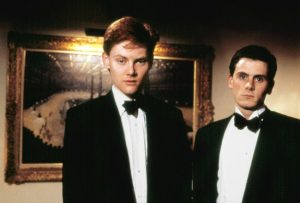
The one who isn’t disgustingly wealthy is named Tom Townsend, played by Edward Clements, and he is the character who is dragged into the cab in the opening scene by Nick Smith, played by Chris Eigeman (the same actor as Jason Styles in “Gilmore Girls!”). Tom arrives to these parties unwillingly, but finds himself reappearing at them after getting hooked on one of the other members there, a girl named Audrey Rouget. They both go back and forth, bickering and disagreeing and falling in love, but fail to alert the other in the mess of hors d’oeuvres and drama.
Around Tom and Audrey, the other characters spin about, discussing such things as marxism, socialism, the horrible being and his atrocities known as “Rick Von Slonecker” as told by Nick, the kind and caring angel of a human being known as “Rick Von Slonecker” as told by every other character in the film, and the barbarism of the current preppy class.
They even decide that, due to this barbarism, their current title amongst society, the name “preppy” or the plural “preppies,” is too ambiguous and inaccurate, opting for the new name they created, “UHB” (an abbreviation of “Urban Haute Bourgeoisie”). Even the characters themselves struggle to define what exactly this immensely ostentatious title means.
So, if there is no clear plot and many somewhat irredeemable characters, why watch “Metroplitan”? Well, because of just that. Whit Stillman fosters a fantastic theme of young romance and haughtiness to this film that is distinct and unseen in any other (aside from the two other recommended Whit Stillman films, “The Last Days of Disco” and “Barcelona”. These three together are casually referred to as a trilogy). These timeless characters and themes are crucial to developing one’s own characters, making this movie renowned by every aspiring writer and conversationalist around the world.
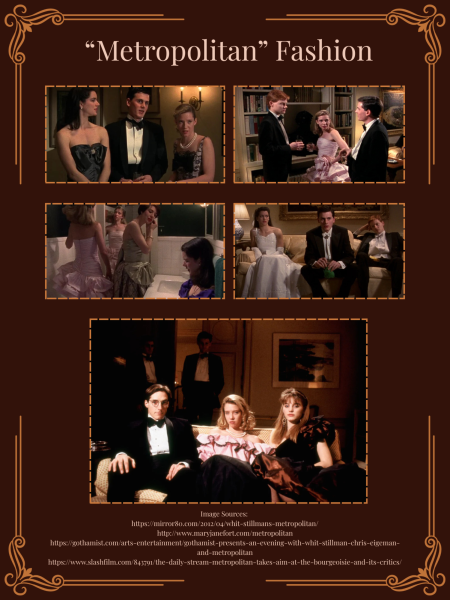
Another reason to watch “Metropolitan” is the fashion style. One of the reasons “Metropolitan” is so popular is because of the outfits donned by the characters, often referenced in modern media. People in the real world who wear this style call it “preppy,” but not the “pink Nirvana sweatshirts and yellow American Eagle smiley-faces” preppy you might be familiar with.
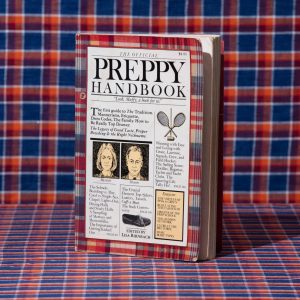
Classic preppy, as dictated by its guide “The Preppy Handbook”, is navy blue pleated skirts, plaid scarves, tan khaki pants, and crisp button-up shirts, all firmly rooted in the same social class as those of Audrey, Nick, and all the other people in “Metropolitan”.
It’s relatively easy to find the corner of Pinterest where these people rave about the outfits in this film. Vogue even wrote an article about their outfits for the 25th anniversary of “Metropolitan!” Many other people have covered the outfits, too, like with Mirror80 and thepreppyhandbookfanclub on Instagram.
Whether you’re interested in writing dialogue, thirsty for a good film, or just looking for a way to up your fashion styling, remember Whit Stillman’s “Metropolitan” for the answer to these problems and more. It can be found for pay on Amazon and Apple TV, and for subscription on The Criterion Collection, HBO MAX, Hulu, and The Roku Channel. And if just one film isn’t enough, don’t forget to check out the next two classic Whit Stillman films, “The Last Days of Disco” and “Barcelona.”