The use of artificial intelligence (AI) has taken a drastic rise in popularity over past years, becoming applied to things such as search engines, consumer technology, engineering, and a variety of other things.
Some of the most common AI platforms for most people’s everyday use are ChatGPT, Goth AI, and Google Gemini. These are “chat bot” style AI applications where you can essentially ask it to do things such as generate writing prompts, organize, and virtually anything else you could need.
Most people have a different use for AI, some use it occasionally as a search engine, some rely on it for a lot of things, and some don’t use it at all. With a resource that has such a wide variety of applications, the music industry has recently started to take advantage of the power of artificial intelligence.
AI can be used in music to generate beats, melodies, freshen up old or low quality audio, and even replicate vocals of popular artists. With the advancing technology behind artificial intelligence, complex prompts and directions can allow the system to generate an entire song with all aspects such as bass, lyrics, and everything else.
While this can be cool to some people, as music generated completely from scratch by a machine is a marvel to what we are able to create as humans, others have serious concern for the matter. Questions of ethics and authenticity have arisen from the recent rise of artificial intelligence in the music industry.
Many believe that what makes real music is the fact that there is human soul and incredible emotion behind the track, and with artificially generated music, you are entirely removing that. There have been thousands of genres and waves of music over the course of time, and artificially generated music is the next one that is already causing a huge impact on artists.
Some artificially generated songs use the voices of real singers and song writers, which many believe will lead to copyright issues, lawsuits, and scams that are driven by AI cloning voices. This is what leads to ethical concerns as well as a distrust among listeners as to what they are actually listening to.
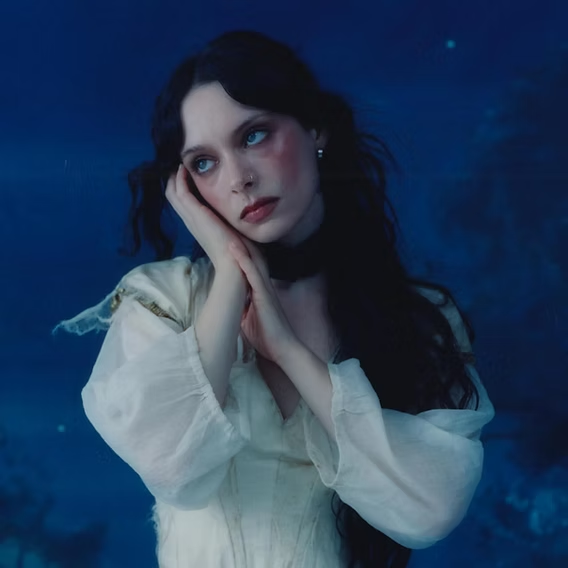
Many artists are creating a persona through an AI platform, generating the music, and then claiming ownership over it. An example of this would be Telisha “Nikki” Jones’ personal AI artist, Xania Monet, who has roughly 45 songs completely generated by SonaAI.
Artificial intelligence is taking a rise in the music industry and is projected to continue doing so. With this comes serious questions of authenticity, ethics, and what actually makes something qualify as music.
Junior Fisher Howald enjoys listening to all genres of music and feels pretty strongly about AI in music. He believes that artificial intelligence takes away from the hard work that real musicians use.
“I think it just takes away from the artists who like to use their own talents to make the music and spend years practicing instruments and everything to be able to perform that music,” Howald said.
Similarly, English teacher Dylan Hostteter believes that AI can be used as a good tool in other applications, but in music, he believes it has no merit.
“I mean, I understand that it can be used as a component as part of a process, an artistic process, and AI could be used for anything else like writing. But I think standing alone, if it’s beats, artist, and every component, I don’t know how much artistic merit it really has,” Hostteter said.
In the future, AI music will significantly rise in popularity and become a common encounter. This will lead to more questions of merit and ethics among those who enjoy listening to music.